
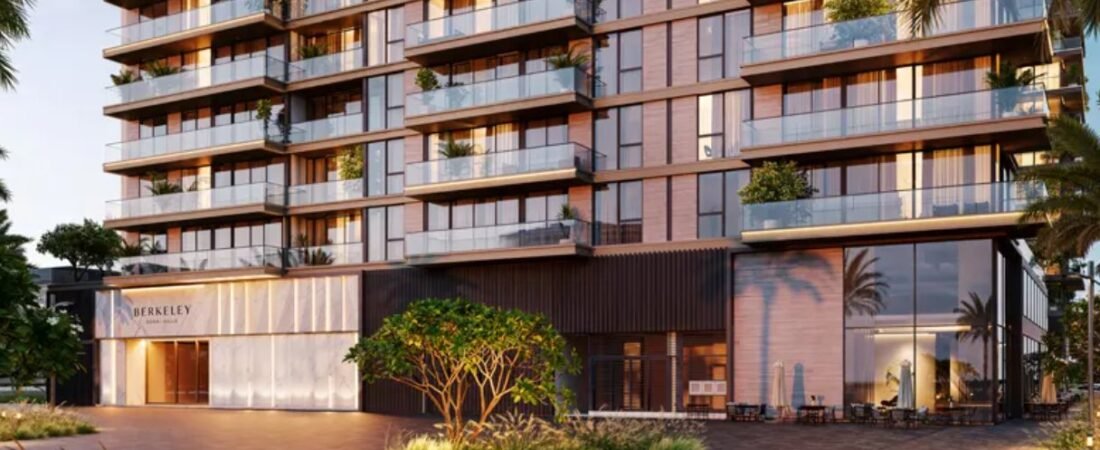
When you buy property in Dubai, you’re not just buying square footage — you’re buying into a vision. The master plan behind a development shapes how you’ll feel walking through the lobby, how your mornings will look, and whether the space will still feel fresh five years from now. Berkeley at Dubai Hills Estate was built with that kind of long-term thinking.
The Big Picture: What Is the Master Plan Behind Berkeley?
Berkeley is part of Dubai Hills Estate — a large-scale, master-planned community developed with one clear ambition: to create a self-contained urban environment where residents don’t have to sacrifice nature for convenience, or community for privacy.
The estate spans thousands of acres and integrates residential zones, commercial spaces, retail destinations, parks, and recreational infrastructure into a single coherent neighborhood. Berkeley sits within this ecosystem as a boutique residential tower — 116 apartments, designed to feel intimate rather than overwhelming.
The decision to keep the project at this scale wasn’t accidental. Soho Development deliberately chose quality over volume. Fewer units means more attention to each one. It also means a tighter, more genuine sense of community among residents — something that gets lost in developments with hundreds of identical apartments stacked floor after floor.
Architectural Concept: Modern, But Not Cold
Dubai has no shortage of glass towers. What makes Berkeley’s architectural approach different is the deliberate effort to balance contemporary aesthetics with livability.
The building’s exterior draws on clean geometric lines and a restrained material palette — the kind of design that ages well rather than chasing trends. Large windows dominate the facades, serving both a visual and practical purpose: they flood interiors with natural light and connect residents to the green landscape below.
Key Architectural Features
- Floor-to-ceiling windows across all unit types, maximizing natural light and views
- Private balconies on each residence — not decorative afterthoughts, but genuinely usable outdoor spaces
- Grand lobby entrance that sets a tone of quiet luxury without being ostentatious
- Open-plan interior layouts that make efficient use of space without feeling cramped
- High-quality finishes throughout — surfaces, fittings, and fixtures chosen for durability and visual coherence
- Smart home integration built into the structure from the ground up, not retrofitted
The result is a building that looks sharp from the outside and feels considered from the inside. For buyers coming from cities like London, Singapore, or New York — places where good design is the baseline expectation — Berkeley meets that standard.
Inside the Units: Design That Works for Real Life
Berkeley offers three apartment configurations: studios, one-bedroom, and two-bedroom units. All come fully furnished, which is worth pausing on — fully furnished in this context doesn’t mean generic hotel-room furniture. It means curated interiors that align with the overall design language of the building.
Studio Apartments
Compact but intelligently designed. The open-plan layout avoids the trap of making a studio feel like a corridor. High ceilings and large windows create vertical and horizontal space that the floor plan alone wouldn’t suggest.
One-Bedroom Apartments
The most popular configuration for young professionals and couples relocating to Dubai. The separation between living and sleeping areas is handled cleanly, and the balcony adds outdoor living space that genuinely extends the apartment’s footprint.
Two-Bedroom Apartments
Designed with flexibility in mind — suitable for families, for professionals who need a home office, or for investors planning to rent to sharers. The layouts avoid wasted square footage while maintaining a sense of proportion between rooms.
The Role of Green Space in the Master Plan
One of the more thoughtful elements of Berkeley’s design is how seriously it treats outdoor and semi-outdoor space — both within the building and in the surrounding community.
Within the development itself:
- Lush garden pathways wind through the ground level, creating a buffer between the building and the street
- A reflection garden offers a quiet, landscaped space for sitting, walking, or simply stepping away from a screen
- The sun deck and pool area are positioned to maximize light exposure and views, rather than being tucked into an unused corner
At the broader community level, Dubai Hills Estate’s master plan places significant emphasis on green infrastructure. The championship golf course — an 18-hole layout at the heart of the estate — functions as much as a green lung for the community as it does a sporting facility. Expansive parks with jogging tracks, cycling paths, and open lawns surround the residential zones.
For buyers who’ve lived in dense urban environments, this access to genuine green space is one of Berkeley’s most meaningful differentiators.
How the Master Plan Handles Connectivity
A well-designed master plan doesn’t just look good on a brochure — it functions. Dubai Hills Estate was planned with circulation in mind: how people move through the community, how they get in and out, and how they access daily necessities.
| Infrastructure Element | Detail |
|---|---|
| Road access | Direct connections to Al Khail Road and Sheikh Zayed Road |
| Dubai Hills Mall | 5-minute drive, 650+ retail and dining options |
| Dubai Hills Park | Walking distance from Berkeley |
| Golf course & clubhouse | Within the estate |
| Mall of the Emirates | 12-minute drive |
| Downtown Dubai | 15-minute drive |
| Dubai International Airport | 20-minute drive |
The road network within Dubai Hills Estate itself is wide, well-maintained, and logically laid out — something that sounds minor until you’ve lived somewhere where it isn’t.
Smart Building, Sustainable Thinking
Berkeley’s architectural concept incorporates smart home technology as a standard feature across all units, not a premium add-on. Residents control lighting, climate, and security systems digitally — a practical convenience that also contributes to energy efficiency.
At the community level, Dubai Hills Estate’s master plan aligns with Dubai’s broader urban sustainability goals. Green corridors, pedestrian-friendly pathways, and the deliberate integration of parks into the residential fabric all reflect a planning approach that thinks beyond the individual building.
For international buyers increasingly attentive to ESG considerations and long-term asset value, this matters. Buildings and communities that are designed with sustainability in mind tend to hold their value better and attract higher-quality tenants over time.
Why the Architectural Concept Matters for Investors
It’s easy to focus on price per square foot and rental yield projections when evaluating an investment. But the physical design of a building is one of the most durable factors affecting long-term value.
Buildings that are well-designed tend to:
- Age more gracefully — quality finishes and considered layouts don’t date as quickly as trend-driven design
- Attract better tenants — professionals and families with options gravitate toward spaces that feel well-made
- Maintain stronger resale value — particularly in a market like Dubai, where new supply is constant and differentiation matters
Berkeley’s architectural restraint — choosing timeless over flashy — is, paradoxically, one of its stronger investment arguments.
Soho Development’s Design Philosophy
Understanding the developer behind a project helps explain the decisions made during design. Soho Development approaches residential development with an emphasis on hotel-inspired living — a concept that influences everything from the lobby design to the concierge services to the finish level of individual units.
The hotel-inspired model isn’t about making apartments feel temporary. It’s about applying the service standards and design discipline of hospitality to a residential context. That means nothing looks improvised. Transitions between spaces are thought through. Materials are chosen for how they’ll feel after years of daily use, not just how they photograph on launch day.
For buyers, that translates into a product that delivers consistently — not just at handover, but as a long-term home or investment asset.
FAQ: Berkeley Dubai Master Plan and Architecture
How many units does Berkeley at Dubai Hills Estate have?
Berkeley comprises 116 residential units across studio, one-bedroom, and two-bedroom configurations. The deliberately limited scale reflects the developer’s focus on boutique quality rather than volume.
Are all apartments at Berkeley fully furnished?
Yes. All units come fully furnished with curated interiors that align with the building’s overall design concept. This includes appliances, furniture, and integrated smart home technology — a significant practical advantage for overseas buyers and investors.
What is the architectural style of Berkeley Dubai?
Berkeley follows a contemporary design language — clean geometric forms, large glass facades, open-plan interiors, and a restrained material palette. The approach prioritizes timeless livability over trend-driven aesthetics, which supports long-term appeal and asset value.
How does the master plan of Dubai Hills Estate benefit Berkeley residents?
Dubai Hills Estate’s master plan integrates green spaces, a championship golf course, retail, dining, and strong road connectivity into a single community. Berkeley residents benefit from walkable access to parks, a five-minute drive to Dubai Hills Mall, and fast connections to Downtown Dubai and the airport — all within a well-maintained, thoughtfully planned neighborhood.
Does Berkeley incorporate smart home technology?
Yes. Smart home systems are built into all units as standard, allowing residents to manage lighting, climate control, and security digitally. This is integrated into the architectural design of the building rather than added as an afterthought.
Why does the architectural concept matter for investors?
Well-designed buildings with quality finishes tend to attract better tenants, maintain stronger resale values, and age more gracefully than trend-driven developments. Berkeley’s architectural restraint and material quality are deliberate choices that support long-term investment performance in Dubai’s competitive real estate market.