
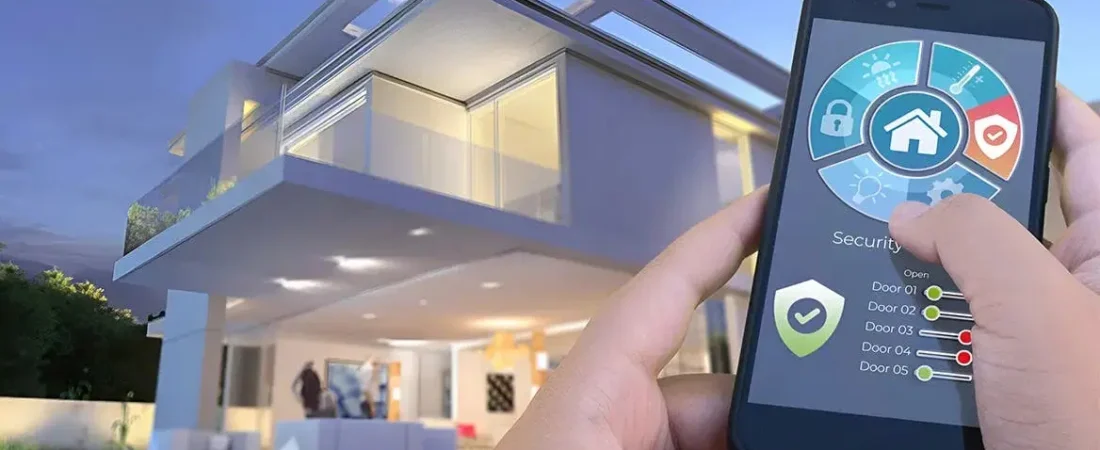
Smart home technology has moved from a luxury differentiator to an expected standard in Dubai’s premium residential market. Buyers and tenants who once treated automated lighting and app-controlled climate as impressive extras now treat their absence as a deficiency. For developers operating in the upper segment of the Dubai Hills Estate residential market, the question is no longer whether to include smart home systems — it is which systems to include, how deeply to integrate them, and how to deliver them in a way that is genuinely useful rather than technically impressive but practically burdensome.
Berkeley at Dubai Hills Estate approaches smart home integration with the same hotel-inspired brief that shapes its interior design and finishing standards. The technology is present to serve the occupant — to make daily life more comfortable, more energy-efficient, and more secure — not to demonstrate technical capability for its own sake. The result is a smart home specification that is comprehensive without being complicated, and that works as well for a short-stay guest using the apartment for the first time as for a long-term resident who has customised every setting to their personal preference.
This article covers Berkeley’s smart home technology in full — what systems are included, how they function, and why they matter for both end-users and investors — without overlapping with the interior design, finishing standards, or amenity topics covered elsewhere in this blog.
The Smart Home Philosophy at Berkeley: Hospitality Logic Applied to Residential Tech
The clearest way to understand Berkeley’s approach to smart home integration is to borrow the lens of hotel operations technology. A five-star hotel room does not ask its guests to configure systems from scratch. It offers pre-set scenes, intuitive controls, and an experience that works immediately for any occupant — whether they are staying one night or thirty. Customisation is available for guests who want it, but the default state is already optimised.
Berkeley applies this same principle to its residential smart home specification. Every apartment arrives with sensible, pre-configured defaults for lighting scenes, climate settings, and security modes. Occupants can operate every smart function from a single interface — whether a wall-mounted panel, a mobile application, or voice command — without needing to understand the underlying system architecture. Deeper customisation is available for residents who want it, but it is never required for comfortable daily use.
This hospitality-logic approach to residential technology has direct commercial implications. It means that short-term rental guests can arrive at a Berkeley apartment and immediately use every smart feature without a technical briefing. It means that long-term tenants experience consistent, reliable automation without maintenance overhead. And it means that investors operating the property remotely can monitor and manage key systems — access, climate pre-conditioning, energy usage — from anywhere in the world.
Lighting Control: Scenes, Schedules, and Atmosphere
Lighting is the smart home feature that most directly and immediately affects the quality of daily life in a residential space. Berkeley’s smart lighting system goes well beyond simple on/off switching — it delivers full scene control, occupancy-responsive automation, and the ability to shift the apartment’s visual atmosphere from bright and functional to warm and ambient with a single command.
Every apartment at Berkeley is equipped with smart lighting control across all rooms. Ceiling fixtures, feature lighting, and balcony lighting are all addressable individually or as grouped scenes. Pre-configured scenes — Morning, Work, Relax, Dinner, Sleep, and Away — adjust multiple light circuits simultaneously to deliver lighting states that match the occupant’s activity without requiring manual adjustment of individual fixtures.
Occupancy sensors in key zones detect presence and can automatically adjust lighting levels — gradually brightening when a room is entered and dimming after a set period of inactivity. This occupancy-responsive logic reduces unnecessary energy consumption without requiring the occupant to consciously manage their lighting behaviour.
Colour temperature control in living areas and bedrooms allows occupants to shift between cooler, more alert light during daytime and warmer, more relaxing light in the evening — a feature that supports circadian rhythm alignment and is consistent with the wellness positioning that Berkeley’s overall concept promotes.
For short-term rental operators, the Away scene and scheduled lighting programmes serve a practical security purpose: maintaining the visual impression of occupancy when the apartment is vacant between guest bookings.
Climate Control: Automated Comfort and Energy Intelligence
Dubai’s climate makes HVAC control one of the most practically significant smart home features in any residential property. Effective climate management is not simply a comfort question — in a city where ambient temperatures regularly exceed 40°C in summer months, it is a health and energy cost consideration that affects both the occupant’s experience and the investor’s operating expenses.
Berkeley’s smart climate system integrates with the building’s central air conditioning infrastructure to provide individual apartment-level control with a level of precision and automation not available through conventional thermostat systems. Each apartment’s climate system is controlled through the central smart home interface, allowing occupants to set target temperatures, schedule climate adjustments, and create presence-based profiles that automatically condition the space before arrival.
Remote access to climate control is particularly valuable for Berkeley’s investor-occupiers and short-stay operators. An investor arriving for a personal stay in Dubai can pre-condition their apartment from the airport, ensuring a comfortable arrival temperature rather than a superheated space that takes hours to cool. A property manager preparing an apartment for a new short-term guest can activate climate pre-conditioning remotely, ensuring that the first impression is one of immediate comfort.
Energy monitoring within the climate system provides occupants with real-time and historical consumption data — allowing them to identify patterns, optimise settings, and reduce utility costs over time. For investors covering utility costs in short-term rental operations, this visibility into consumption data is a meaningful tool for cost management.
Access Control: Keyless Entry and Remote Management
Conventional key-based access management is one of the most operationally awkward aspects of property ownership and rental management — particularly for the short-term rental investor who must coordinate key handovers with guests arriving at varying times across different days. Berkeley’s smart access control system eliminates this friction entirely.
Every apartment at Berkeley is equipped with a smart lock system that supports multiple access modes: digital PIN code, proximity card or fob, mobile application unlock, and where supported by the system configuration, biometric access. The master access credential for the apartment owner can be used to generate temporary access codes for guests, cleaners, maintenance personnel, or property managers — with each code independently time-limited to a specific access window.
For short-term rental operators, this access management capability transforms the guest check-in experience. Rather than physical key exchanges that constrain arrival times and require coordination with a local representative, guests can receive their time-limited access code digitally before arrival and let themselves in at any hour without human intervention. The access code automatically expires at checkout time, eliminating the need for key return and ensuring that previous guests cannot re-enter after their booking period ends.
Remote locking and unlocking from the mobile application gives property managers full access oversight regardless of their physical location. Access logs recording all entry and exit events provide a complete digital record of who has accessed the apartment and when — a security and accountability feature that is particularly valuable for investors managing their property from overseas.
Security Systems: Monitoring, Alerts, and Peace of Mind
Beyond access control, Berkeley’s smart home security specification includes a broader suite of monitoring and alert systems that provide continuous protection for the property and its occupants.
Integrated door and window sensors detect any unauthorised opening event and trigger immediate notifications to the registered owner via the mobile application. Motion detection within the apartment — configurable to activate only when the Away mode is active — provides a secondary layer of intrusion detection that operates independently of the access control system.
Video door entry systems allow residents to see and communicate with visitors at the apartment entrance before granting access — a feature that integrates with the smart lock system to allow remote door release from anywhere in the world. For investors and property managers, this means that service personnel, delivery agents, or maintenance staff can be admitted remotely without requiring the investor to be physically present or to provide permanent access credentials.
Integration with the building’s 24/7 security infrastructure — monitoring rooms, CCTV network, and concierge systems — extends the smart home security layer beyond the individual apartment to the building level. Residents benefit from both their apartment’s individual smart security systems and the building’s professional security operations as complementary layers of protection.
Integrated Control: The Single Interface Experience
One of the most important practical decisions in smart home design is how the various systems — lighting, climate, access, security, entertainment, and building services — are brought together into a single, coherent user experience. Systems that require separate applications, separate interfaces, and separate configuration processes are not genuinely smart homes — they are collections of individually connected devices that happen to share a building.
Berkeley’s smart home specification is designed around unified control. All addressable systems within the apartment — lighting, climate, access, security, and building service requests — are accessible from a single interface: a wall-mounted touch panel positioned in the apartment’s main living area, mirrored by a mobile application available for iOS and Android.
The wall panel provides the default, always-available control point that requires no device, no connectivity beyond the building’s local network, and no learning curve. The mobile application extends this control to any location in the world — allowing full system management from a smartphone regardless of whether the user is in the apartment, in a meeting across Dubai, or in a different country entirely.
Scene-based control — where a single command activates a pre-configured state across multiple systems simultaneously — is the user experience model that makes this unified interface practically useful rather than theoretically elegant. The Good Morning scene, for example, might simultaneously adjust lighting to a bright natural setting, set the climate to a specified daytime temperature, and deactivate the overnight security motion detection — three system commands delivered through a single interaction.
Smart Home Technology for the Short-Term Rental Operator
The cumulative effect of Berkeley’s smart home specification is particularly significant for investors operating short-term rental programmes. Each individual feature — keyless access, remote climate control, lighting scenes, security monitoring — provides discrete operational value. Together, they fundamentally change the economics and scalability of short-term rental management.
Keyless access eliminates the physical key coordination that makes self-check-in impossible without a local representative. Remote climate pre-conditioning ensures every guest arrives to a comfortable apartment regardless of when the property manager last visited. Automated lighting scenes reduce the guest onboarding experience to a single instruction rather than a room-by-room tutorial. Security monitoring provides continuous protection between bookings without requiring physical inspections.
For investors managing their Berkeley apartment from outside Dubai — or managing multiple properties simultaneously — these smart home capabilities represent the operational infrastructure that makes remote property management genuinely viable. The technology does not replace professional property management, but it reduces the frequency and urgency of physical site visits and expands the range of management tasks that can be handled remotely.
Smart Home Value for Long-Term Tenants
For long-term tenants — the professional, family, or corporate occupant on a 12-month or longer lease — Berkeley’s smart home systems provide a different but equally significant set of benefits. Rather than operational convenience for a manager, the value here is experiential: daily comfort, personalisation, energy efficiency, and security that accumulates over the duration of the tenancy.
Long-term tenants in premium furnished apartments increasingly expect smart home functionality as a baseline feature of a premium rental. The ability to control lighting, climate, and access from a phone — and to customise these systems to personal routines and preferences — is now part of the value proposition that justifies a premium rental rate over comparable properties without smart integration.
For investors on the long-term rental strategy, Berkeley’s smart home specification supports the rental premium that the property commands over standard residential units in Dubai Hills Estate. It is a tangible, daily-use differentiator that tenants experience every time they walk through the door, every time they adjust the temperature, and every time they leave the apartment knowing the security system has activated automatically.
Technology That Serves the Living Experience
Berkeley’s smart home specification is not a feature list — it is an integrated operational framework that makes the apartment work better for every type of occupant, every type of investor, and every management scenario. It is the technology layer that makes hotel-inspired living a daily reality rather than a marketing concept: the lights that adjust to your mood, the apartment that cools before you arrive, the door that opens with a code sent from the other side of the world.
For investors, it is the infrastructure that makes remote management viable, short-term rental operations scalable, and rental premiums justifiable. For residents, it is the daily comfort layer that makes Berkeley feel different from every standard apartment in Dubai Hills Estate.
Frequently Asked Questions
What smart home systems are included as standard in every Berkeley Dubai apartment?
Every apartment at Berkeley includes the following smart home systems as standard: unified lighting control with scene programming and occupancy sensing across all rooms; smart climate control with remote access and scheduling integrated with the building’s HVAC infrastructure; smart lock access control supporting PIN code, proximity card, mobile app unlock, and temporary access code generation; door and window intrusion sensors with mobile push notifications; video door entry with remote unlock capability; and a unified control interface available via wall-mounted touch panel and mobile application for iOS and Android. All systems are pre-configured with sensible defaults and are operational from the day of handover without requiring additional installation or configuration by the buyer.
Can the smart home system be controlled remotely from outside the UAE?
Yes. Berkeley’s smart home mobile application connects via the internet rather than requiring local network proximity, meaning full system control is available from anywhere in the world with a smartphone internet connection. Remote capabilities include: activating and deactivating security modes, adjusting climate settings and pre-conditioning the apartment before arrival, generating and revoking temporary access codes for guests or service personnel, viewing door entry camera feeds, and receiving real-time security alert notifications. For overseas investors managing their Berkeley apartment remotely, this remote access capability is one of the most practically significant features of the smart home specification.
How do temporary access codes work for short-term rental guests?
The smart lock system at Berkeley supports the generation of unique, time-limited PIN codes that are valid only for a specified date and time range. The apartment owner or property manager creates a guest code through the mobile application, sets the validity window to match the guest’s check-in and checkout dates and times, and shares the code with the guest digitally — via email, messaging app, or booking platform communication. The code activates automatically at the check-in time and expires automatically at checkout, requiring no manual deactivation. Multiple codes can be generated simultaneously for different access purposes — guest code, cleaner code, maintenance code — each with its own independent validity window and access log record.
What happens to the smart home systems if there is a power or internet outage?
Berkeley’s smart home systems are designed with resilience considerations appropriate for a premium residential building. The smart lock system includes a battery backup that maintains lock function — both locking and unlocking — during power outages, preventing occupants from being locked in or locked out due to a building power event. Climate control reverts to its last active setting during brief outages and can be restarted from the central panel once power is restored. In the event of an internet connectivity disruption, all smart home functions remain accessible via the local wall-mounted panel — only the remote mobile application functions require an active internet connection. For specific details on backup power specifications and failsafe configurations, buyers should request this information from the Soho Development technical team during the purchase process.
Can the smart home system be upgraded or expanded after handover?
Berkeley’s smart home infrastructure is built on an open architecture that supports system expansion and device integration beyond the standard handover specification. Residents who wish to add additional smart devices — supplementary sensors, additional cameras, smart appliances, or voice assistant integration — can typically do so within the system’s compatibility framework. Specific integration possibilities depend on the hub and communication protocol used in Berkeley’s installation, which buyers should confirm with the development’s technical team. For investors planning to enhance their property’s smart home specification for the premium short-term rental market, understanding the system’s expandability at the point of purchase allows them to plan any upgrades as part of their pre-letting fit-out process.